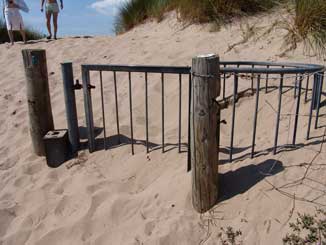
This page takes you to some trampled dune areas. Here is Formby, on Merseyside, and here Aberffraw dunes on Anglesey off the North Wales Coast
The virtual study, though, takes us to the Skallingen Peninsula, on the Western side of the Jutland, part of Denmark. A general view is here, and a closer one here. This dune system was studied in the 1970s by T. Hylgaard and M. J. Liddle, their paper is in the The Journal of Applied Ecology, Vol. 18, No. 2. (Aug., 1981), pp. 559-569.
They did a number of things, but the main one was to simulate different levels of trampling on these dunes, and then study the effect on such things as the depth of the paths, the total vegetation cover and the effect on a variety of common species. Not surpisingly, looking at photos like this:
This shows the effect on the total cover of vegetation:
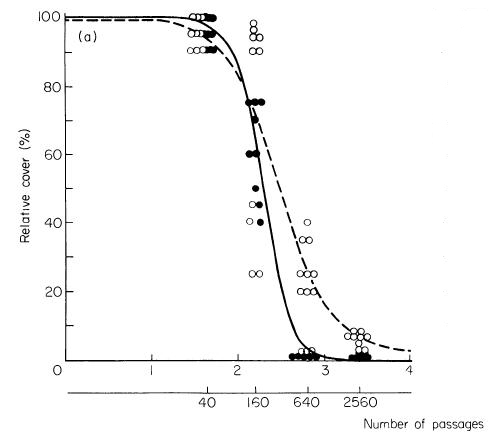

Their study involved trampling by a certain amount (up to 2560 times, they call a time a passage) either all on one day, or over a period of 4 months. How would you say that trampling effected total relative vegetation cover and what difference does concentrated, as opposed to long term, trampling make?
Finally, the graphs for individual species were as follows (the meaning of 'number of passages transformed' should be apparent from the graph above):
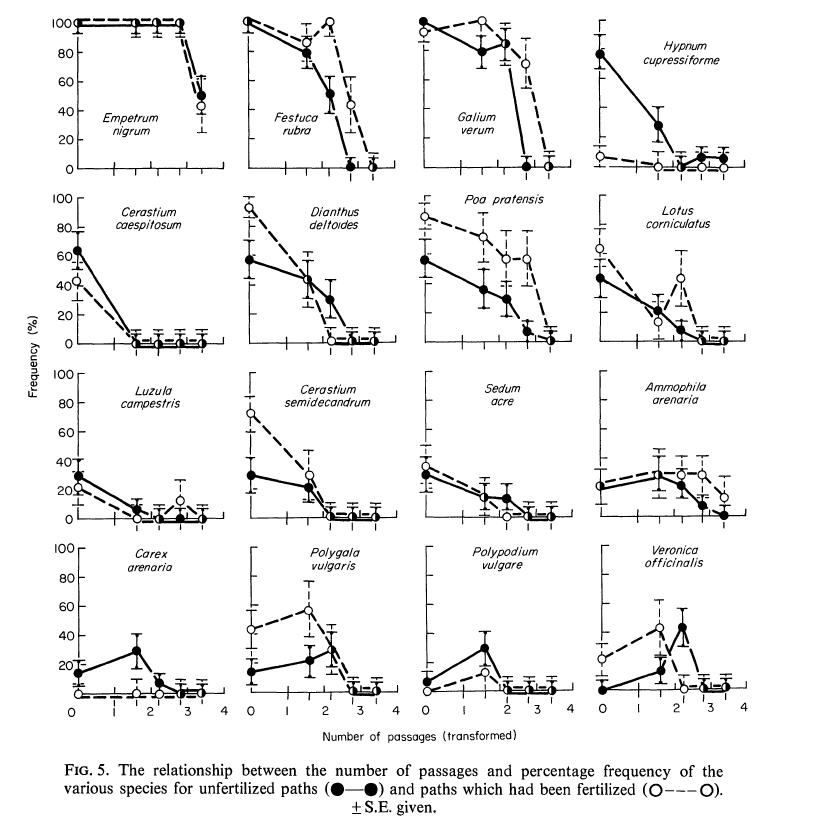
A further experiment is also shown here in which fertilizer was added to some paths but not others. Some suggestions had earlier ben made that this would increase the chance of plants surviving the trampling. Do you think this is true for any of these plants and, if so, which? Do you think adding fertilizer is a good way of trying to protect dunes from the effects of trampling?